
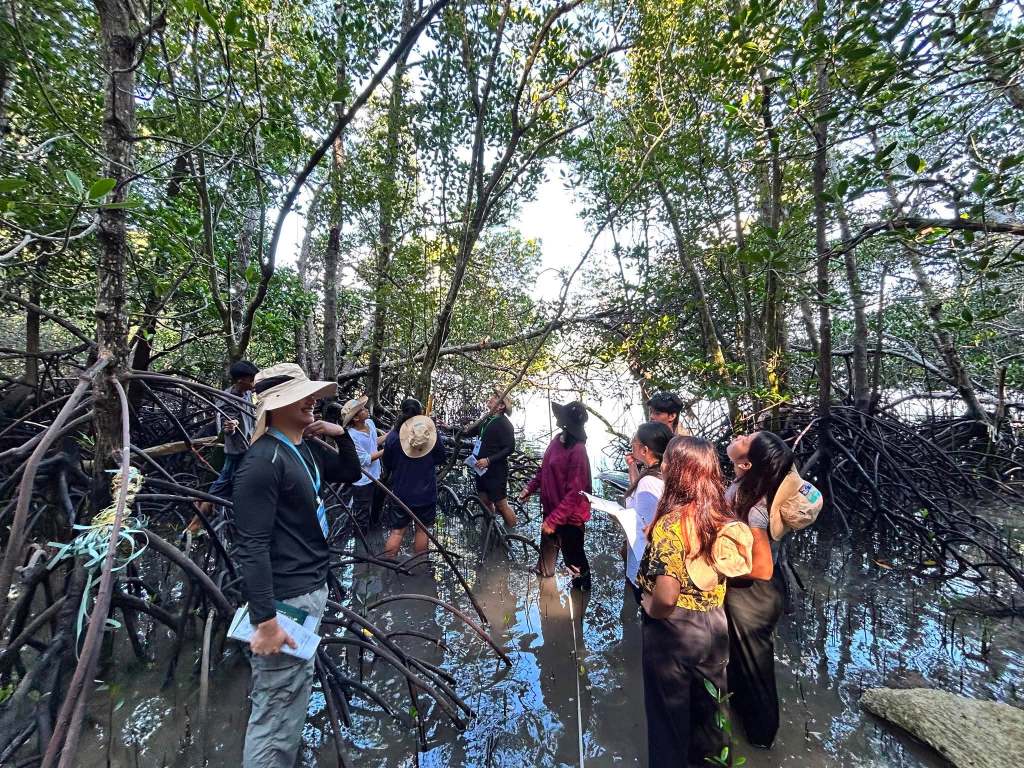
MANILA — Seventy young leaders from across Mindoro Island have launched a peer educators’ network aimed at strengthening youth participation in environmental protection, climate resilience, and local governance.
The Mindoro Youth Network for Bluer Coasts was established during Tugdaan, a three-day peer education training held from July 31 to Aug. 2 at Buyayao Island in Bulalacao, Oriental Mindoro.
The participants, composed of young leaders, Sangguniang Kabataan (SK) representatives, and youth advocates, underwent training to enhance their knowledge and leadership skills in environmental conservation, climate resilience, and peer education while laying the foundation for a youth-led network that will promote healthier coastal ecosystems and resilient communities across Mindoro.
“Tugdaan,” which means “seedbed” in the Alangan Mangyan language, is a program that develops youth peer educators drawn from youth organizations, community leaders, and SK representatives throughout the Mindoro Island cluster.
The initiative combines classroom discussions, field-based learning, and collaborative planning to equip participants with the skills to promote environmental stewardship, engage fellow youth, and contribute to local environmental governance.
The training is implemented by PATH Foundation Philippines Inc. (PFPI) through the ADAPT for Bluer Coasts and Community Resilience (ADAPT) Project, a four-year initiative that seeks to strengthen climate resilience in vulnerable coastal municipalities in the Mindoro Island cluster.
Supported by the United Kingdom government’s Foreign, Commonwealth & Development Office through the Climate and Ocean Adaptation and Sustainable Transition (COAST) Facility, the project adopts the Protected, Productive, and People (3Ps) framework to advance nature-based solutions, sustainable livelihoods, and inclusive marine governance.
PFPI said Tugdaan is envisioned as a continuing program sustained through a youth-led network of peer educators that will continue collaboration and environmental action beyond the life of the ADAPT Project.
“Through the network, we hope to institutionalize a mechanism where youth champions for the environment can continuously empower themselves to catalyze behavior change among their peers and become active citizens participating in governance bodies,” ADAPT Project Program Manager Recamar Guiñares said.
Participant Frecious Margaret Valdez of Victoria, Oriental Mindoro, said she plans to apply the knowledge she gained during the training in her community.
“Halimbawa po sa pagtatanim ng mangrove, kasi ito po yung meron sa aming barangay. Sa lahat po ng naging activity, mas natatatak sa puso ko po ang pakikinig sa mga information sa iba’t ibang species sa ating mangrove, coral reefs, and seagrass, kasi konti pa lang yung information ko dati about doon,” Valdez said.
Wred Gaba, an environmental science student from Mindoro State University, said the experiential learning activities, particularly the seagrass assessment exercise, left the biggest impression on her.
“Kung kaya’t ang gagawin ko po ay maging isang mahusay at matalinong peer educator na kung saan lahat ng natutunan ko dito sa Tugdaan 2026 ay hindi ko lamang basta ibabahagi sa kanila kundi mas ipapaintindi ko sa kanila kung gaano kasarap ang magmahal ng ating kalikasan. Isa sa mga pinakanagmarka sa akin at isa sa mga pinakamalapit na talaga sa puso ko ay yung mga aktibidad nila kagaya ng assessment sa mangrove, sa corals, at sa seagrasses. Isa ako sa mga participants na napasama sa seagrasses, hindi dahil kakaunti ang may gustong matuto kundi dahil ito talaga yung gusto kong matutunan,” she said.
PFPI Executive Vice President Dr. Joan Castro said the organization has promoted peer education for the past three decades as an effective approach to addressing interconnected population, health, and environmental concerns.
“Naniniwala kami na kapag ang kabataan ay nabibigyan ng tamang kaalaman, kasanayan at pagkakataong mamuno, nagiging mas matatag ang mga tao, ang komunidad at ang ating kapaligiran. Simula rin ito ng paghubog ninyo bilang isang leader at tagapaghatid ng positibong pagbabago,” Castro said in her message to the Tugdaan peer educators.
Tugdaan was co-convened by the ADAPT Project in partnership with the Department of Environment and Natural Resources Mindoro Biodiversity Corridor Project, the Bureau of Fisheries and Aquatic Resources, and the local government of Bulalacao. It also received support from the provincial governments of Oriental and Occidental Mindoro and several local SK councils and federations.
Oriental Mindoro Vice Governor Jojo Perez also expressed support for the initiative during a courtesy meeting with the organizers.
“I will always support the youth and initiatives in environmental conservation,” Perez said.
 Life Today PH
Leave a comment